Uninvested in Being Beautiful

As I’ve gotten older (and here I use “older” cautiously since I’m only in my thirties), one of the more unexpectedly pleasant aspects has been my growing invisibility to younger people. I’ve been fat my entire life, and as a result there hasn’t been a time when seeing a cluster of young men (or, for that matter, young women) out in a public place– especially in a scenario when I have to walk past them–didn’t stiffen my back and set my teeth on edge in anticipation of the coming harrassment. But my age is slowly taking that away. Few groups are as offensive to the cultural consciousness as youthful fat people, because it’s like a car crash of antithetical concepts: if youth is beauty and fat is ugly, than a young fat person is willfully bastardizing the treasure of youth. Or so some would have you believe. Combine this with the natural inclination of young people to be powerfully fixated on physical appearance and you have a recipe for an environment that’s especially hard on fat kids.

Recently I was walking into a local department store, and a cluster of boys in their late teens were standing near the front doors, talking. A slender young woman walking in front of me passed them, and all three watched and assessed and traded insights. As I approached them on my way out, I felt that familiar adrenaline rising, fists clenching, prepared for fucking war, as though I’m waiting, someday, for the time when I will inevitably, finally snap and physically assault a person for saying the wrong thing to me at the wrong time and in the wrong tone of voice (it may still happen, someday).

But the boys barely glanced at me. And I could relax, reminded that I’m slowly becoming irrelevant, which is troubling on some levels, particularly ones relating to sexism, but is a massive relief on others.

One of the more common sentiments expressed by the women of More to Love was the ultimate goal of “feeling beautiful”. While the objective truth of an individual person’s beauty is up for debate–and acknowledging the question of whether an objective beauty exists at all, being ultimately in the eye of the beholder–the feeling of beauty is something else altogether. It’s internal, it’s visceral, it’s a deep, penetrative assurance, it’s something you get in your very cells. It’s not necessarily something that has any visible effect on how symmetrical a person’s features are, or whether her hair is shiny and flowing, and so forth. It’s not tangible.

When the fat women of reality TV told of how they “felt beautiful”–to the object of their affections or just to the television audience–my husband would ask me, often with a bit of a sideways glance, “Do I make you feel beautiful?”

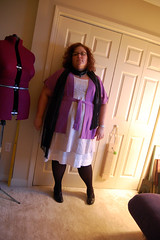
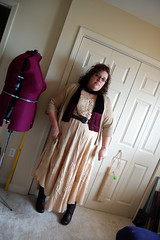
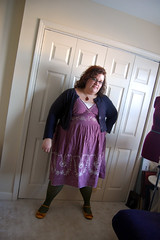
This is a question with a complex answer and likely one I’ve never fully expressed with accuracy. I would typically tell my husband, “I believe that you think I’m beautiful,” and, “You make me feel loved,” both of which are true, but neither of which is the same as feeling beautiful myself. The fact of the matter is that I don’t feel beautiful, pretty much ever. Before you frown at this sympathetically, dear reader, allow me to also note that I don’t feel as though I’m missing anything in this way. I am, frankly, uninvested in being beautiful.

I don’t receive hate mail very often at all; maybe a couple times a year. This surprises me considering I am pretty open on this blog, about my background and my size and what I look like. I would expect telling the story about being nicknamed “obese” as a kid or frequently posting photos of myself here, would make me a favored target. But on the rare occasions when I do get hate mail, it’s only ever a slam on my appearance, and given that my lack of beautifulness is probably the least sensitive part of my psyche, I’m perversely grateful for this.

My most recent anti-admirer said something to the effect of my being painful to look at, which did nothing so much as remind me of Angela Chase and “You’re so beautiful, it hurts to look at you,”. This is especially apt considering that when Angela suggests this phrase as something she wishes someone would say to her, it’s difficult to imagine it happening then, to a skinny, self-absorbed teenager whose awkwardness is part of what makes her appealing, but who probably wouldn’t get broad majority support for a vote of “beautiful”, at least not at that age, in that situation. When My So-Called Life was on the air, Angela Chase and I were the same age–actually, I think I was a year older–but at the time I could only feel her insecurity and her sad teenage pain and I heard her voice her wish for the most romantic thing she could imagine hearing and I connected with it. I watch her now and can only think of how young she is and that while the character is relateable and her story compelling, she is also somewhat embarrassing, in retrospect. Were we all like that? Were we all so hopefully and hopelessly self-involved, so committed to being special and unique and beautiful in whatever way we choose to define it?

Elsewhere, the November issue of Glamour has arrived and, as promised, features more naked plus-size models and a lot of self-congratulatory back-patting on Glamour’s part for their progressiveness and willingness to buck the oppressive norms of the fashion industry… at least for one article in one issue. This piece is likewise steeped in the language of beauty, advocating that women of a certain size sure can be beautiful, boy howdy! But of course there are limits–lest anyone think Glamour is irresponsibly promoting self esteem and self acceptance, they are sure to remind us that “obesity is a significant health problem,” and that these models aren’t obese (except when they are).

It’s fun to play at being beautiful, like little girls playing dress-up in our mothers’ clothes. Everywhere we look we’re confronted with messages instructing us that to be beautiful is to be feminine, or at least that we ought to aspire to beauty even knowing that the vagaries of popular culture and genetics may ensure that it’ll always dance just beyond our grasp. This unites women as much as it divides them and sabotages and swallows energy that might have been better put into non-beauty-focused endeavors. As critical thinkers, we ought to be aware that being beautiful is an option and not a requirement. Even for the aforementioned women, who shoulder a disproportionately-high measure of the beauty burden.

You do not have to be beautiful. It’s not your responsibility to be beautiful, for yourself or for anyone else, not for your family or your partner or your friends or some stranger on the street who finds your face unpleasant (and let’s be real here–the most beautiful woman you can imagine will occasionally have folks thinking she looks busted). “Beautiful” is a loaded concept, encumbered with implications far beyond the dictionary definition. It’s a vehicle on which we can put our deeper worries, our fears that we’re not good enough, our insecurities, our sadness. It’s easier to say “I feel beautiful!” than it is to say “I feel confident!” “Beautiful” is a feeling that’s okay for a woman to express; often, “confidence” is not. But that’s a conflation of two discrete concepts. When we use it in this way, “beautiful” becomes a code word we employ when we can’t get at our deeper feelings, or at least when we can’t express them in a culturally-acceptable way. Feeling beautiful is often about nothing so much as feeling accepted, loved, appreciated, respected, and feeling those things about oneself from the inside, as well as feeling them as they are expressed by other people.

When my husband asks if I feel beautiful, I have to say no; because I never feel beautiful by its strictest definition; because I am not a beautiful girl. I am rather a woman who knows where she stands, who feels comfortable and confident in her own skin, and yet who struggles daily with living in a world that tells her repeatedly that she shouldn’t feel this way, that she has no right to feel this way.

Our beauty, or our feelings of beauty, are often feelings we guard as ferociously as we would a priceless treasure. Probably because for many of us this feeling comes all too rarely. But if I might interrogate our assumptions for a moment: what do we really mean when we talk about feeling beautiful? We mean that we feel good about ourselves, don’t we. We mean that we feel happy and confident and alive, and the fact that this combination of feelings is so rare and so magical and so intoxicating that we have to call it “beauty” just breaks my heart.

That feeling is beautiful. But you don’t have to be beautiful, to feel it.

20 Responses to “Uninvested in Being Beautiful”

  1. bigmovesbabe responded:

    Yes, yes, yes. It’s the flip side of using “I feel fat” to convey feeling like shit.

    The times when I “feel beautiful”, I recognize as the times when INSIDE I feel some outrageously good feeling and maybe I happen to look at myself in the mirror or in a window walking down the street and it feels like I am feeling that feeling so strongly that I can almost see it radiating from my pores. Whether I just rolled out of bed, or I feel like dancing hard, or I’m wearing my favorite sweater, or I’ve got a great day to look forward to, those are the times when I feel beautiful. Whether or not someone enjoys looking at me at those times, is irrelevant to the feeling.

  2. suburban hobbit responded:

    This is exceptionally good, and it helps me to sort out some thoughts of my own that can be hard to keep straight. On the one hand, I don’t want our cultural beauty standards (which shift and narrow on an irregular basis, but which have been pretty much anti-fat as long as I’ve been here…) to exclude women who look like me, as some kind of matter of principle. So I needle my students and friends just a little when they treat the properties of beauty (or, alternately, attractiveness) as obvious and exclusive ones. But on the other hand - while I’m not prepared to say I am wholly uninvested in being beautiful; there are moments of weakness - I’m not encouraging myself to grow up to be a person who wants or needs to be regarded that way.

    Still, (on three other spare hands I will produce from within the rolls of my fat): 1) I’m unattached and can’t seem to help wanting very much to be *attractive* to other people - which is easy to confuse for being beautiful to them, 2) the flipside: I still sometimes fear being repugnant to other people, even though, as you say, that’s inevitable for pretty much everyone, and 3) even on my firmer, less anxious side (uh, I don’t mean flesh - all my sides are equally squishy!), I really like fatshion and self-presentation, and my efforts in that field have been known to be fairly elaborate. It’s sometimes hard, esp. within our cultural context, for me to keep dressing up for the sake of my own creativity separate from dressing in such a way as to cajole others into approving of my appearance (and thereby my person?) It can sometimes be hard for me to make sense of my interest in clothes, given my - general - disinterest in vanity.

    Anyway, the essays here get better and better all the time. This one gave me loads to think about (and look forward to, with respect to my thirties, heh heh. I’m almost there, but apparently I’m still routinely mistaken for a college co-ed. How?!! I has teh wrinkles, lemme be too old to bother already!) I look forward to your next piece, and if you find anything else to recap (surely there must be something, somewhere in the world to recap!) I am sooo there.

  3. snarly responded:

    wait, i can’t let go of “I don’t feel beautiful, pretty much ever.” this makes me sad…tho i recognize that this is MY issue, not yours. you’re uninvested in being beautiful, but you ARE invested in fashion and being creative and witty with your clothes. (and you are.) so what’s the distinction? what if we swapped the word beautiful for “funky” or “snazzy”?

    i’m having trouble b/c humans have always been drawn to beauty…tho bien sur cultural definitions of beauty have differed widely. i don’t think it’s weak (to use another commenter’s word) to be drawn to beauty and want beauty for yourself. it’s human. any individual can of course opt out of the beauty game, and rock on with your (self-defined!) unbeautiful self. (see me resisting the urge to say “I THINK YOU’RE BEAUTIFUL!” b/c i want to respeeect your chooooices, man.) but it’s also legit to work on broadening everyone’s notions of beauty, making them more inclusive and more informed by the fact that our world is so much bigger (in every sense — americans are bigger and our universe is more global and connected and visually accessible in all its diversity) than ever before. broadening our notions of beauty doesn’t just mean GO FATTIES but also appreciating looks that don’t fit our cultural norm in other ways: race and age come to mind.

    another blog i read regularly is Advanced Style — i LURV looking at pictures of the nattily turned out old people. which makes me think: how much of beauty is about face/body and how much is about STYLE? you like STYLE, right? i’m older than you, in my 40s, and i want to age like those Advanced Style ladies — maybe with crazy dyed red hair or maybe with sophisticated black and gray eileen fisher-esque layers, dunno yet…but i know i don’t want to opt out. i care! but i also get the minefield of “look good but don’t look like you’re trying too hard and don’t look like you’re clinging to youth but don’t ‘let yourself go’ either…” it is ass. it is enuf ass that i totally get saying fuck beauty. i saw a pic of naomi campbell, who is theoretically 3 yrs younger than i am, and her newly altered face is startling. DO NOT WANT. yet i saw a pic of myself from 12 yrs ago, and gee, um, wah.

    anyway. complicated. appreciate your thoughts on it and thanks for letting me spew.

  4. Lesley responded:

    but it’s also legit to work on broadening everyone’s notions of beauty, making them more inclusive and more informed by the fact that our world is so much bigger

    I absolutely agree with this, and I support those who work hard to address it, but it’s not so much the battle I’m personally fighting. I don’t have the patience. So often, in my experience, this approach is limited to a broad cultural result of simply moving the goalposts but still being exclusionary. So Glamour tells us women who wear up to and including a size 12 can be beautiful–the takeaway message isn’t “let’s learn to see the beauty in everyone”, it’s “maybe women who wear up to and including a size 12 can be beautiful too!”* This is wonderful for women who fall into that category, but it still means those larger than them get shunted into the unacceptable/soon-to-die-of-obesity-epidemic bin.

    Now! I love Advanced Style. And I do understand your points about not wanting to opt-out entirely. But when I talk about beauty above, what I’m really trying to get at is that undefinable aspirational beauty, the idea that every woman should be reaching for a feminine ideal, even a feminine ideal that keeps changing, rather than getting to know herself as she is. I saw this often with the ladies of More to Love; they’d say something like “He makes me feel beautiful!” but the subtext was always “…in spite of my being a giant fatass, and having all this internalized body hatred!” Never just “beautiful”, end of line.

    It’s true that I love style. But I don’t think style has to be tied up with beauty. If I had to choose a word for what drives my commitment to style and fashion and all that rot, it’d be a desire not to be beautiful, but to be interesting. I do what I do, fashion-wise, more to challenge my own and other people’s aesthetics than for any other reason. The best compliment anyone can pay me, truly, is to tell me I look interesting–even if they don’t dig what I’m wearing.

    Or maybe I am totally unconsciously trying to be the postmodern 21st-century fat-girl version of Oscar Wilde. Ha!

    *So long as they subscribe to our magazine, follow our diet tips, buy the clothes we tell them, etc. It may be obvious here that I have gripes with the aspirational nature of a lot of fashion journalism.

  5. buttercup responded:

    ” It’s not your responsibility to be beautiful, for yourself or for anyone else, ”

    When this finally hit me, it was SO freeing. A combination of age, fat, and I-don’t-give-a-damn finally did it. And it is awesome.

  6. forestroad responded:

    I have always struggled with the concept of “beauty”…I find it impossible to judge whether or not someone is beautiful without meeting them. If you show me a picture, I might be able to unpack “aesthetically pleasing” “interesting” “put together” “confident” “hot” and “happy”, maybe even “pretty”, but “beauty” is something I can only behold after getting to know someone. I think all my friends are beautiful, though they meet cultural definitions of beauty to varying degrees, I suppose.

  7. CollieMom01 responded:

    For me, being beautiful is akin to being validated. Which is kinda sick, when you think about it. But I suppose that in the culture in which we live, it’s the norm more than the exception. I’ve long forgiven my dad for the constant criticism, couched in terms of “teasing” about my weight, my make-up, my Karl Malden nose, my ass, my hair–and why was I so sensitive, anyway???, but the truth is that all I wanted was his approval. And I guess for many girls/women, that’s where we’re trained to go. If I look good and he approves of me, then I must be beautiful. It’s the work of a lifetime to get beyond that, I think. But when I consider your question about My So Called Life, and whether we were all so self absorbed at that age, I have to answer “Yup”, as I know that I certainly was. Age and maturity has a way of softening that need, and I have days in which I certainly feel good about myself, but I still have to admit, that in my little heart of hearts, I want my husband (whom I adore, and whom I know loves me)to tell me I’m beautiful. And he doesn’t ever say that. Clearly, I am still a work in progress………..

  8. thirtiesgirl responded:

    I have no problem saying “I feel beautiful” when I’m feeling confident, respected, loved, recognized. To me the word “beautiful” doesn’t represent the feminine ideal, even a changing one. I don’t aspire to any feminine ideal except my own. When I like the outfit I’m wearing (or am happy with my hair, makeup, shoes, etc.), when I feel like I’m doing a good job at work, when I feel recognized for my accomplishments and can recognize them for myself, I feel beautiful. When the guy I’m dating tells me he finds me attractive, intelligent, thoughtful, etc, I feel beautiful. Not “in spite of my fat ass” (or in my case, my disproportionately large hoots, belly and chins), but just beautiful. I can’t really explain why that is. It just is.

    …Well, maybe I can. Even when I was a teenager, I never wanted to be considered “so beautiful, it hurts to look at me.” I wanted to be seen as real, touchable, not some item on a pedestal that can only be adored, “too painful” to look at or even touch. I think that came from years of living with a mother with borderline personality disorder who was literally unable to recognize my feelings, and by the same token, unable to recognize me as a person separate from herself. In other words, unable to recognize me as an individual. I wanted to be seen as real, even with “all my fur loved off,” to borrow a line from The Velveteen Rabbit. And I think that desire to be real wiped out any false notions of beauty or a feminine ideal that I might have aspired to.

    And if you think it’s great that you’re no longer caring what the kids think in your 30s, just wait ’til your 40s. It keeps getting better. :)

  9. nikiknits responded:

    Your post brought up so much for me. I still, to a much lesser degree than when I was younger (I’m 34 now), ache to be beautiful. Beautiful in the “off the rack” definition mostly . . .

    As a child, I was given the classic fat little girl message so clearly that I have such a pretty face, if only, blah blah blah. Part of my personality, which is a strength and a challenge, is that I want to please others and I have struggled for most of my life not to let myself be defined by how I think others view me. I think most women in the dominant culture are taught that their worth comes in large part from their value as an object or an end to other means, which lead me to unconsciously reach the conclusion that being fat and not conventionally pretty, I would not have much worth.

    This then is where beauty, fat, gender and a whole host of other issues end up getting tangled in a big mess. Luckily, I got angry instead of complacent as I came into womanhood and fortunately, tenacity and pure stubbornness are also traits of mine! Most days adult me is able to navigate the mess pretty well and I don’t trip the wire on the beauty trap. I am successful, confident, willful and just fabulous. Then there are the times where I feel about as emotionally mature as six year old me, being put on my first diet and thinking that must mean I am ugly and worthless.

    I too though have found the further away I get from my twenties, the less it matters and the less I care. Yes, it disturbs me that on some level I become more invisible as I age, but I am loving the freedom that I am finding in it.

  10. abby responded:

    I often want to respond but find that I get a bit shy and flustered : )) If I never open my mouth here again, know that my heart too is relieved by this particular invisibility. I feel like I’ve been waiting for this to happen since I was a teenager. I love living just oustide the realm of partying and popularity, where speaking with my own voice is enough and being who I am is just right.

    Style is terribly important to me. While beauty doesn’t figure prominently in my life, I do think it’s interestingness that takes its place; or, the brand of interesting that is most definitely ‘abby.’ What I wear has that quality, but so does the space I live in, the art I create, and the very particular way I have of encountering the world and the people in it. It’s a much better compliment from me if I say ‘I like that’ than if I say ‘That’s beautiful.’

  11. kellyhogaboom responded:

    I am devastatingly beautiful to my children - they tell me this everyday and they really mean it. They must mean something different than pretty much every other person out there.

  12. arasaig responded:

    wow, i was just thinking about this last night. Growing up I received compliments both positive and negative, but the ones that I paid attention to were the ones from strangers. Not any strangers, but men walking or driving down the street shouting at me that I was ugly, I was fat. My best friend thought I was making it up or being overdramatic, when finally about three years ago, it happened when she was present. She couldn’t believe it. It had never happened to her and it happened to me three or four times a week. As I have gotten older and fatter, strangers don’t pay attention to me anymore. It’s such a psychological relief that I have finally gotten freer with my behavior. I can walk along the street with my head up and wear what I like. I can accept compliments. I feel sexier and more attractive and more comfortable in my own skin now that I ever have. I no longer worry about whether I am pretty, but whether I am happy or comfortable. It’s freedom. I just accepted I am not beautiful and never will be and started living by my own standards. By societal standards (middle-aged and fat), I am less attractive than I have ever been, but on a personal level people are much more responsive to me and I receive more compliments and positive attention than I ever have.

  13. twoseamfastball responded:

    So, this was the post that finally made me sign up here.

    I’m younger than you, still squarely in that “oh lawd, she’s wasting her youthful years!” space. I have a friend (a fat and ‘conventionally pretty’ [whatever that means] friend) who always says things to me like, “You’re so pretty!” I know she means well, but usually I roll my eyes when she does, or I say something along the lines of, “Aw, thanks, but not so much,” which just makes her start getting insistent.

    I feel like this is the same as when people say, “Oh, YOU’RE not fat!” That classic bit where they actually mean, “Oh, you’re not hideous/lazy/slovenly/gluttonous/stupid/poor/whatever other adjectives have been packed into ‘fat’ lately,” instead of just fat, by itself, a simple adjective without the baggage. For my friend, when she says, “You look pretty, really!”, what she means is something more like, “I love you as a friend, you have value to me, you’re a good person, etc.” Physical beauty, to her, isn’t just an aesthetic quality, it’s a whole series of connotations and social luggage tags, and to deny that I possess it is tantamount to announcing that I have some sort of sewer-level self esteem. A cry for help! Well-meaning platitudes to the rescue!

    I AM fat. I am NOT beautiful. Babe, it’s just not the way I’m set up. On a good day I’m ‘interesting’. And the thing is… that’s fine. When I say I’m not beautiful, it doesn’t feel like a low-self-esteem thing, it feels the same as saying that I’m fat– a statement of fact, and so what? It doesn’t mean I want to look like shit all the time, I’ll still try to dress in things that fit and look good on me and whatnot, but the overall effect still is not going to be beautiful, like no matter what I wear, the overall effect is never going to be ’skinny’.

  14. emilylzbth responded:

    I have such mixed feelings about this topic. But you saying that we don’t have an obligation to be beautiful for ANYONE was pretty freeing. For me, at least, it’s a strange concept. Yes, I’ve been made fun of a LOT in my life for being ugly/fat, but mostly in my childhood. Since I’ve grown up a bit, say since age 16 or so (I’m 22 now) I get called beautiful…. well…. pretty often. I am death fat, too (size 26.) I’ve had, on several occasions, complete strangers (men and women) stop me and tell me how pretty I am. It’s a total mind fuck, though. Society tells me I MUST be beautiful, but I can’t be beautiful AND fat. And then strangers stop me and tell me how pretty I am, but I know in the back of their minds they’re thinking (”but shame about that body.”) Maybe it’s strange or selfish, but I absolutely hate being the pretty fat girl. I am young, pretty, and fat. People seem to find this highly offensive for some reason. Like I’m wasting myself or something. It’s fucking terrible. Sometimes I want to be terribly plain or get to that stage in my life where people don’t even notice me. I can’t wait.

  15. living400lbs responded:

    I think I let go of wanting to be beautiful somewhere between the computer science degree and paying off my student loans and other debt. To me, both of these meant that I was capable of achievement and did not need to be beautiful to live my life.

    Shortly thereafter I began dating someone who told I was beautiful quite often. It was … strange.

  16. hornsandthorns responded:

    I love it. I have similar feelings. I have tried to explain it but people often don’t get it and say, “No, no, you ARE beautiful!” But I am not, in the traditional sense, and I’m perfectly fine with that. I don’t need to be beautiful. Most people aren’t considered beautiful. Why is that a bad thing?

    At the same time, I know that ‘beautiful’ is the term that we use when we want to tell people we care for them, and also, that many other people do care about whether they’re beautiful. I tell my mom that she is beautiful, and she is - to me. But I know that she isn’t beautiful in the traditional sense, she is just beautiful to me and others who love her. She likes hearing it. I suppose there is a bit of a disconnect in my brain on this concept.

  17. Dreamy responded:

    I actually kind of always wanted to be so beautiful that it hurts to look at me. Because maybe then people would stop looking at me. :/

    I guess I figured if I was beautiful enough, then I’d be unapproachable, and realized recently that, on some level, that was my aspiration. I still don’t really want to be approached by men about 98.5% of the time (and I’m straight). I guess, somehow… I thought being stunningly, unquestionably beautiful (because that’s totally objective and attainable) might actually reduce the amount of harrassment I got for my “sleazy” body. Because… Yeah, I guess if you’re “beautiful” and not just “fvckable” or “sexy,” that puts you closer to Madonna than whore. IDK…

  18. truelove responded:

    So Glamour tells us women who wear up to and including a size 12 can be beautiful–the takeaway message isn’t “let’s learn to see the beauty in everyone”, it’s “maybe women who wear up to and including a size 12 can be beautiful too!”* This is wonderful for women who fall into that category, but it still means those larger than them get shunted into the unacceptable/soon-to-die-of-obesity-epidemic bin.

    Oh, god, thank you for summarising that so distinctly. My housemate was talking about Glamour magazine and all that very positively and I was having a very hard time articulating all the ways in which it still deeply troubles me. Sure, it’s nice that they’re showing a slightly (and, of course, only *slightly*) broader range of body types — but there’s still no true acceptance or peace-with-self-and-others there.

    I also particularly resented the implication that got made that because women up to size 12 were now being shown, why, *my* body is represented in there now! No. It’s not. There is a rather significant difference between a slenderly-built 5′9″ blonde who weighs ~150lb. and is a size 12, and myself. I have no problem with her being featured in the magazine as such (despite the fact that I am really deeply troubled by the fact that it is still within an exclusionary paradigm).

    But I am 5′6″, weigh anywhere from 165-175lb depending on the week and the phase of the moon and the alignment of the stars, and my proportions are the sort that have historically been called hourglass and has been simultaneously sexualised and demonised and dealt with in a problematic ways, and all of which means that my body? Is not being shown in there. Don’t tell me that it is. It’s not.

    And yeah. I really don’t like the idea that oh, well, these women are “normal”… unlike those truly fat, obese women. Who we can’t possibly just accept as they are and realise that it’s not our goddamned business what size or shape or health they are.

    (Tangentially, one of the things that has been most freeing about finding the fat and body acceptance movements was just letting go of all that inappropriate worry I had for my husband and my parents over *their* bodies. Not just in really accepting how much bullshit the skience behind the fear of fat is but also in the reminder that it’s *not my goddamned problem*. Not even with my husband. It’s just not something that is my worry or concern to deal with. As much or more than anything else, that is what I value from body acceptance and this blog and others like it — the tools to free myself from that prison of fear and worry.)

  19. AlwaysSilky responded:

    I grow SO weary of feeling I have to be the poster child/inspiration for my large size sisters. I think it’s truly an age thing… at 38 I just dont have it in me on the daily to paint up and be dressed to the nines, etc. Thank God INDEED for the invisibility that comes with age…. I’m in it for comfort. I’ve gotten in the habit of nearly shaving my head because I can do it myself (avoiding paying a barber a grip and being in line in there all day) I’m tired of the Unholy Trinity (Lane Bryant, Avenue, Ashley Stewart)… Torrid’s clothes are too young for me (and they DONT fit)… so I make my own clothes. Other ppl make a fuss over me because I’m supposedly “beautiful”… what I am is a fat girl with a pretty face. Can we move on and conquer some real sh*t? Kthanksbye!

  20. wriggles responded:

    I agree that we are cheated out of our inborn self esteem which is based on our mere existence.

    “That feeling is beautiful. But you don’t have to be beautiful, to feel it.”

    Agree with this too.

    So, could the fact that we are amongst those more likely to be sidelined by the beauty club be an example of fat privilege?

    I mean, we know it’s b/s right? So if we are forced out of it, aren’t we doing better than those who are co opted. Especially regarding age. I think this can make ageing easier for a fat person, on average.

Comments are moderated; if your comment doesn't appear immediately, it has been sent to the moderation queue and will be approved shortly.

Buy contemporary bedding bedding toile bedding.
  
Site Resources
Home
About Us
Join the LiveJournal Community
Join the Flickr Pool
Browse Online Shop Reviews
Search the Site
Grab the RSS Feed
Contact Us

Member Login


Lost Password?
No account yet? Register
We have 5 guests and 2 members online

This Week's Unstapled Poll
In trying to keep up regular exercise, which of these best motivates you?
 

Support Doctors Without Borders in Haiti

Recent Shop Reviews
eShakti: Nice clothes, lousy service (2.8)
Category: Online Shops: United States
eShakti: Disappointed in eShakti (1.8)
Category: Online Shops: United States
eShakti: Overall very good (3.2)
Category: Online Shops: United States
Macy's: Macys.com customer service is STUPID bad (1.6)
Category: Online Shops: United States
eShakti: Good and Bad (3.6)
Category: Online Shops: United States

Recent Comments
Eco friendly kitchen accessories chefs kitchen 1 kitchen tool.

In the Media


Fatshionista! on Facebook

Digable Links
The Adipositivity Project
Afrobella
Angry Black Bitch
Axis of Fat
Big Fat Deal
Body Impolitic
The Curvy Fashionista
Definatalie
Every Body is Beautiful
Fat Lot of Good
The Fat Nutritionist
Feminists with Disabilities (FWD)
Living ~400lbs
The Musings of a Fatshionista
Notes From The Fatosphere
Nudemuse
The Pretty Year
The Queer Fat Femme Guide to Life
Racialicious
The Rotund
Shapely Prose
Silentbeep
Threadbared
The Well-Rounded Mama
Young, Fat, & Fabulous

Fatshionista - Flickriver
 
top of page
© 2010 Fatshionista
Joomla! is Free Software released under the GNU/GPL License.